
Welcome to Weddings Unscripted!
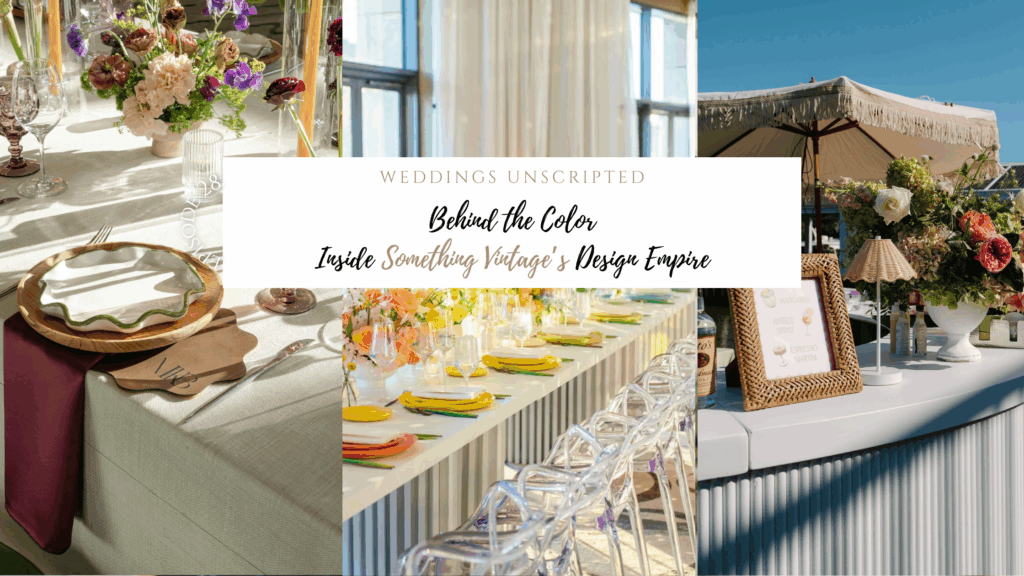
Ever wonder how a vintage rental company became one of the most trendsetting forces in the DC wedding scene? In this episode, we sit down with Dawn and Molly of Something Vintage — the powerhouse duo redefining event design through color, craftsmanship, and creativity.
From humble beginnings collecting teacups to running a 35,000-square-foot warehouse, Dawn shares how her leap from the CIA to design entrepreneurship turned into a bold, thriving business. Molly joins in with insights on leadership, logistics, and what it takes to keep an ever-growing creative team aligned (and inspired).
Together, they reveal the behind-the-scenes systems that keep Something Vintage running—from custom-built bars to nationwide linen shipping—and how they stay ahead of design trends that shape weddings across the country.
What we discuss:
[00:01:18] – Dawn’s unexpected career pivot from the CIA to weddings
[00:06:49] – Molly’s path into events and how business savvy fueled their rapid growth
[00:09:01] – How Something Vintage sets national trends (and what happens when China copies them!)
[00:18:48] – The birth of their custom linen line and how they scaled nationwide shipping
[00:25:57] – Why booking early is essential—trucks, timelines, and logistics behind the scenes
[00:34:10] – Wild weather, rain plans, and lessons learned from unpredictable event days
[00:40:48] – The real challenges of warehouse life (and the math behind getting furniture into elevators)
[00:46:08] – The creative social media strategies that built Something Vintage’s iconic brand
Key Takeaways:
- Trendsetters, Not Followers: Something Vintage doesn’t wait for inspiration—they create it, leading the way with original designs and bold aesthetics.
- Kindness Counts: The team reminds us that compassion and respect between vendors are what make event days seamless and enjoyable.
- Social Media with Purpose: Their content isn’t just pretty—it educates, entertains, and builds community within the industry.
Connect with us:
Visit our website: www.weddingsunscripted.com
Cherry Blossom Weddings & Events: www.cherryblossomwe.com
Follow us on our socials:
Facebook: https://www.facebook.com/profile.php?id=61572429101755
Instagram: @weddings_unscripted
TikTok: @weddings_unscripted
Connect with Something Vintage:
Website: https://www.somethingvintagerentals.com/
Facebook: https://www.facebook.com/smthingvintage/
Instagram: @smthingvintage
TikTok: @smthingvintage
Transcript:
[00:00:00]
Alex: Welcome back to another episode of Weddings Unscripted. As usual, I’m [00:01:00] joined by my co-host, Ali. How you doing, Ali?
Alison: I am doing great. Hello, everyone.
Alex: Wonderful. We have some very special guests for you today. I feel like maybe I say that all the time, but we just truly, truly love our partners in this industry. So we have Dawn and Molly from Something Vintage.
Something Vintage is this incredible decor rental company. Dawn has really pushed the boundaries with colors and styles and fabrics, and it’s just really, really made, designing weddings in DC just so much more dynamic. So with that, Dawn, could you just tell us a little bit about how you started something vintage and a little bit about your background as well?
Dawn: Hi. Sure, yes, I’m Dawn, i’m the President and Creative Director at Something Vintage. The way I started, this is kind of funny, weird story, but, I was collecting vintage China and vintage dining chairs for my first wedding [00:02:00] and I was a terrorism analyst, with a CIA at the time, and I had gone to school for that. I have a master’s in Islamic studies.
Alison: I never knew this. This is wild. I feel like I’ve known you for years.
Dawn: Yeah, I studied Arabic for 12 years and like lived in the Middle East in different places, when I was collecting all of this and designing my first wedding, that one, I’m not meant to sit behind a desk ’cause I’m like super ADHD, but I don’t think my creative skills were really being put to use and I just didn’t wanna sit behind a desk anymore.
So I knew our wedding was gonna get published, on Style Me Pretty. So I’m like, you know what? There’s not another like vintage rental company out in the DC area. Maybe I can like run with this. So, before it was published, I made a website and then I had style me pretty linked all the rentals to my website.
And then we started getting inquiries and my very first client is someone that still we rent to today, [00:03:00] Taylor but she was our very first client. I think she rented like vintage tea cups or something, but now we have a big 35,000 square foot warehouse. But when I started it was like in my house and in my basement.
And when she came to look at the rental, she came to my dining room in DC. So yeah, that’s the story behind it.
Alex: That’s incredible. What year was that?
Dawn: I launched it in 2012. While I was working for a long time, I guess like three years and I hired someone to help me with emails and I just realized like, oh. things were really picking up and I just felt like if I really wanted to make go of this, I have to take the leap because like things were picking up and I feel like I have to be in charge of this 100% of the time and full time.
So I quit the government job and it was quite a leap. And I probably shouldn’t have at that point, but I did. And somehow we all we made it work.
Alex: I think that’s great and a quick nod to your business savviness to really think about like, oh, it’s gonna be [00:04:00] published on this national platform. Let me just get this website up quickly and like link things together. that’s amazing.
Dawn: Well, thank you. I think I really wanted to change careers.
Alison: And that’s the funny thing. I think some of my favorite conversations, and these happen a lot with wedding vendors, is like, all right, how’d you get started? We’re having coffee, or we’re having lunch and we’re just getting to know each other. And they’re like, I couldn’t sit at my desk job anymore.
And I feel like that’s probably like 80% of how people just stumble into the wedding industry is they realized how creative and fun and stressful, we do wanna put that out there, that this is not an easy transition. Maybe moving from the CIA, it was a little bit easier, maybe not as stressful as that, but still very stressful.
Dawn: Yeah, for sure. I never thought I would be a business owner and I think back sometimes, my mom encouraged me to, minor in business in college, and I remember saying, mom, I’m never going to run a business. Why would I do that? Why would I minor in business? But it turns out [00:05:00] that I did and it has been very helpful.
Alison: if anyone doesn’t know Dawn, we’ll link their website and their social medias. But she is one of the most fashionable person I know, in this area outside of a few other people. And her style is so fun and bright and colorful and unique. And I feel like that also is a testament to your company that you’ve been able to bring some of your personal style into what you love doing now.
Dawn: You know what’s funny though? I always like I did not fit in dress fashion wise in the government at all.
Alison: And so I’m curious, were you able to like, have personal style with your job or was it just like pants suit, dark colors and now you get to be fun and vibrant?
Dawn: I always had a pop of color no matter what, and I always had like, something going on, like whether it was ruffle blouse or like pattern tights, I definitely like, was still extra, but I couldn’t be like, extra, extra. But now, I do not wanna wear blazers or button up shirts because I feel like I’m so [00:06:00] done with corporate America and like the government and I’m like I cannot make myself wear a button up shirt now.
Alex: Molly, let’s talk about you a little bit. How long have you been with Something Vintage and what is your journey in this wedding world? We’d love to hear about that.
Molly: Yeah. Hi, guys. I have been with Something Vintage for a little over five years and it’s been a true passion of mine to join, and I do usually go on, a slight tangent talking about I have a very extensive career path in events, specifically in the DC market. I’ve been in the industry for about sixteen years. But finding Something Vintage has really been like a way to align a lot of my, like, logistics and event sales passions, but also with design and color and being able to like kind of express in that way. I have a lot of experience with corporate event design. I was with Dmcs for many years.
I’ve worked in a lot of different facets of the business, so I feel like I’ve been kind of able to bring like that side of thinking and mindset to Something Vintage, but you guys kind of touched on business savvy for Dawn and I think that that will be a [00:07:00] theme that we kind of keep coming back to.
And that’s a reason that we’ve been able to grow so quickly and make such an impression on the industry is that she just, like, kind of see the vision and we can act quickly and invest in the right pieces. And she is a risk taker and acts quickly. And we were able to like come up with something, put a plan in place and move on and get it done.
And I think that’s like really special to Something Vintage and why we’re so special. We just like can make it happen and we don’t get set up. We don’t get like stuck in the minutia of like, how are we going to get this done? We just get it moving. So it’s been really a joy to be a part of and really fun.
I think in the past five years, the growth that we’ve seen is incredible and we’re still going and we have huge goals. So it’s been really fun for me and it’s a thrill to be a part of for sure.
Alex: Well, being part of something that keeps going and growing while having all the excitement of design and decor. You know, we were talking, we did a episode before Mary Margaret, just like, sort of celebrity gossip and like what’s [00:08:00] Taylor and Travis gonna do, and whatever they do will impact the wedding market, you know, so, it’s always changing.
You never know why trends are gonna happen, but I think it’s so fun that you get to go shopping for it all. And then some of your photo shoots are great and just seeing what, clients put together, the green plate, the black plate, like all of it. There’s so many different ways you can present it all.
Molly: Yeah. I do think Something Vintage has a hand and is responsible for a lot of the trends that we’re seeing in the industry. We try to get out in front of it, and that’s something that’s very important to us. So a lot of our styled shoots and tablescapes that we put together and ways that we think about incorporating and building new inventory, we try to be the first and we try to make sure we’re doing things that haven’t been seen. And I think you can kind of see that ripple effect in the way that trends are shaped with some of the inventory that we’re driving. So I think that’s pretty cool. And when we try to do trend predictions, like we really pull from a lot of different inspo, but especially, Dawn’s vision and things that she sees coming down the pike. I like to think that we’re trying to lead that cause [00:09:00] in a lot of cases.
Dawn: It’s kind of funny. I design all of our bars and backdrops and everything, and I’ll sketch it out and our carpentry team here will build it, and like, I’m not mad, but we’ll get catalogs from China with the pictures of power bars that like I literally designed and now they’re reselling and like, sometimes their pictures just stolen from our website.
They don’t even just like make a new one. They just take our pictures and I think it’s a compliment in many ways, but in that way we do see a lot of the things that we are creating kind of spread. Across the country and around the world because they’re reselling them. That’s, how we try to think of it because it is in China, there’s nothing we can really do about it.
Molly: For sure producing it and selling it to our competitors. So it’s definitely something that’s happening. But we just use it as like more encouragement to transition and make new things. So We, kind of not dwell on that as much and just crank out new inventory and keep it moving.
Dawn: [00:10:00] I don’t know if you guys know this, but we have our own pottery studio. So we make and design a lot of our own plates, and we came up with this ruffle plate we call the Tuscany with a black outline on it, and another rental company asked to wholesale them and like buy them from us.
And we’re like, no, we’re not gonna do that one. We don’t have the capacity. But no. And then they had trying to make them, they’re like very similar. And I’m like, oh my gosh. But you know what? We just keep creating and moving on. And I think that is something that like does set us apart is that because we can make things and try them quickly here, we don’t have to wait for the back and forth from an importer like China.
Like, you know, the design process when working with a Chinese company is really long because we say we want something, we design it, they make it, they ship it to you, you, need give ’em feedback and it can be like over a six month process. But if we’re just making it, we can do that pretty quickly and experiment and see what we like, what we don’t like, what needs to change, and [00:11:00] then boom.
Alison: So it’s just dreaming it up, pulling it out of your brain, explaining it to someone, have them make a mockup, go, yes, that’s what I was thinking, and then creating it from there. That’s really cool. One thing I wanna stress for those that are listening that might not be familiar with Something Vintage, and they soon will be as they’re going to be investigating you after this, but your company not only creates, but it also finds, like you mentioned with your first business model is finds vintage pieces and then refurbishes them, gives them a new life and then has this kind of modern take on these vintage pieces. And that’s kind of really your bread and butter where you started and now you’ve morphed and molded into i’m also building, I’m also creating, we have this pottery studio, which I’ve seen in person and it is insane. It is so cool. And we’re gonna talk about how much you’ve had to expand your warehouse. And I remember talking to you guys years ago on like, well, one day we’re hoping to get that space there and that [00:12:00] space there, and I think you have them all now.
So I’m excited to talk about that too. But right now I wanna talk about where are you shopping for these things? Like where are you finding some of your vintage pieces? How long does it take you to kind of flip them and how do you know what you’re looking for? Or is it when you see it, you know it?
Dawn: Great questions, it’s evolved over the years. Honestly, when I started in 2012, you know, it was the peak of the barn rustic wedding trend. Right. So some of the things I was looking for then were very like victorian because one of those Victorian sofas in a barn for their wedding. Like that is where it was at. But as trends have evolved in interiors even and in wedding industry, the kinds of pieces that we’re buying vintage are like different. So, we went through the mid-century phase and now I think we’re more like in the postmodern eighties and seventies stage with a lot of curves and not like sharp corners, right?
Like curved [00:13:00] sofas and that type of thing. When I first started, and I totally forgot about this until my husband mentioned it the other day, I was like Craigslisting like all the time. I was on Craigslist, nonstop estate sales, like you name it, I was doing all of that but, crisis has kind of died out and Facebook marketplace seems to be like where it’s at now.
And so I have a couple people that I buy from routinely that are collectors, and then we just are always all looking on Facebook marketplace for really unique pieces. Right now we are really hunting for bird coffee tables. So, we have a little collection of bird and swan tables, and then we’re always trying to add to it because it’s very unique and fun and it just brings that colorful, fun pop to a lounge.
we have a white one and I’m thinking about other animals to incorporate. I think we’ve been talking about some leopards, et cetera.
Alison: Oh, that’s fun. my clients, used your two bird ones, your pink and your teal one, and they were so fun on site and they’re so unique.
Dawn: [00:14:00] And that’s what, like while we do make a lot of our things, I think incorporating vintage furniture into a lounge is what really makes it stand out and have style. Because it’s not just this manufactured pieces that you get from China or Wayfair and they all look the same all across the country.
Like, that makes it really unique and I think it is a standout for your guests. And I think it’s like that in homes too, right? Like vintage pieces are like the things you love and like really makes your home indifferent and unique.
Alex: They’re unique and special.
Alison: And then pivoting off of that. How do you, get it in, you then go, okay, this is feeling like it should be read to me. Like, how is this happening?
Molly: We try to make a lot of those decisions, based on trends we’re seeing in client needs that we need to fill. We can kind of see like colors trend over time, and some things are more popular for certain segments of the market than others. And then, of course, from an upholstery standpoint, like rental furniture does [00:15:00] tend to take a beating.
So we’re pretty frequently, reupholstering and maintaining those pieces. And so when it’s time to reupholster, something like the whole team will kind of sit together and talk through, like, you know, it’d be really nice if we had another piece in this sage fabric or we haven’t really done much with red, and we’re seeing a lot of red requests coming through.
Like maybe we should look into some new upholstery fabrics that can meet that need. We try to maintain those pieces as long as we can, but what’s really cool is that because it’s vintage, no two pieces are the same for the most part. But because we can maintain the fabric and we control the upholstery, we’re able to have the fabrics that speak to each other and everything can kind of mix and match and keep it in the color story. So those are important pieces to that as well.
Alison: And you have all of this in house, we wanna stress that to everyone listening. This is all in house, that your team is the ones reupholstering, fixing up, cleaning, all of that. Correct.
Dawn: Our team, maintains all of the pieces. And like, let’s say the frame is [00:16:00] like a super dark wood, like we’ll strip it or bleach it before we reupholster, but we do work with upholsters in the area. We don’t generally reupholster things ourselves. We don’t have that in house.
Molly: But, we have a partner that we trust that can get it done pretty quickly.
Dawn: Just to highlight one thing Molly said is that we will reupholster things like chairs, sofas, satis, all in the same colorway. So even though they’re vintage pieces, they are a part of a collection that’s cohesive. So like all the emerald velvets are all the same. So. They all look great together in a lounge.
Alison: And then Molly, well, you didn’t mention your title. We’d love to hear kind of like, your exact role within the company, because you said you’ve been there for five years and did you start in this role or did you kind of like work your way up to that?
Molly: I joined Something Vintage in twenty twenty one at the height of Covid. So I was in the events industry for many years, and of course we all kind of experienced [00:17:00] some shuffling during that time and I sent a Hail Mary email to Dawn pretty much being like, I must join this company. Like, I realize we’re in the middle of Covid and she responded to me like ten minutes later and brought me in and we had a conversation. And, you know, at that time, the team was much smaller, the operation was a little different than it is today. And she was kind of like, sure so, I joined as part of this, sales team a little loosely.
There were very few of us at the time, and just, like, learn the business very quickly. That was right around the time that we started to see the DC events market start to crawl back and I love the business, I love the events industry. And I was able to jump in and we made some big changes.
We changed a lot to the way that we do sales and the way we structure our business, and we grew the team. I have a team of three other sales execs underneath me, and we really just built it up and had a huge year in twenty twenty two, and it continued to grow and continued to grow. And I’m sure we’re going to touch on this, but we launched into linens and linen production [00:18:00] and, the operation just continued to grow.
The business grew, the revenue grew, and Dawn and I kind of just kept talking about, well, what about this? And can we do this? And so, yes, currently am the vice president of sales and business development. That is something that I’ve acquired over time. And we’ve just grown together.
And it’s an honor. I mean, I live and breathe Something Vintage. So probably many listeners out there have encountered me somehow, whether it’s via email or at an industry event, but we love it. And, you know, we have a lot of big goals ahead of us. So more to do and more to grow for sure.
Alex: That’s amazing. It’s just been so fun to see your growth as well. So you guys are doing great things. So you mentioned linens of seeing some of your email blasts, all the right colors. Tell us more about linens and your shipping and are you guys doing like nationwide shipping at this point?
Dawn: We are, when we first started linens, it was a big leap to do because the upfront equipment cost was a lot of money, and because of COVID, they [00:19:00] were backorder like a year. So you know, we had to pull all this money out there, wait for these machines, and it was like a year after that we finally got them. But we first started, we were getting a lot of our designs from India. like they were all block printed and cool, but we quickly learned that they just didn’t hold up over time. They were cotton and they faded and it was really hard for quality control purposes to have that relationship in India. So, we started printing them in house. We figured out somehow dye sublimation.
We got a dye sublimation printer and heat press and we have been making our own designs and fusing them ourselves. And that’s been really incredible because, we can make things really quickly ourselves. So let’s say things get damaged as they do in the linen world. We can print and sew new ones pretty quickly to make sure we fulfill all of our customer orders.
Alex: That’s [00:20:00] amazing that you guys can do that that fast. People are like, how do you damage linen? Well, red wine spills on it. I mean, there’s so much that can happen.
Alison: That’s why some venues say you can’t have tapers and you’re like, I don’t understand why I can’t. It’s ’cause it drips wax everywhere. So unless a florist does protective measures, it can probably really destroy a linen.
Molly: Fun fact that we are currently learning and navigating is that yes to spills, yes to candle wax, but mold is actually becoming one of our biggest killers on linen. So that’s been fun to navigate.
Alison: Meaning like if it was to sit in a bag, like at a venue before a truck can pick it up and it starts sweating, there’s lots of heat and stuff. And then by the time you get it back in your warehouse to wash clean press it, you’re finding mold.
Molly: That cycle could be as little as, like three to four days. So it’s pretty quick.
Dawn: We process our linens, as soon as they come back, we’re not letting them sit at all. It’s just sitting at a venue or on a [00:21:00] UPS truck. It just happens.
Alison: And the reason I wanted to clarify that is so people listening, like hanging in your warehouse and just being pressed and cleaned is not gonna grow the mold. It is the process afterwards. And that’s where like why we wanted to talk to a rental company so bad was like, you guys have so much inventory, but you lose a lot of it. Like it’s also your glassware. It’s like breakage on plates. You think like people stealing things too.
Molly: The asset. management piece to the rental side could probably be its own episode, for sure.
Alison: Which we definitely wanna go over, but we do wanna stick within this new exciting thing that you have, which is your linen and your shipping.
Alex: What other products are you guys excited about? Or what else are you thinking about expanding to? Because I mean, just so for our listeners to hear, you have everything tabletop, so, flatware, plates, glassware, all kinds of stuff. Now, linens.
Alison: Napkins and bars, bar backs, you have small stages. Like they literally have almost everything. And if [00:22:00] they can and want to, they will also build something too.
Dawn: All of our non breakable items. So anything for the table that’s non breakable, like flatware, we ship very frequently. Place mats, napkins. Pillows, you name it, we’ll ship it.
Alison: Yeah, and so for some of your custom builds, ’cause you guys just made something for us actually. We did a huge wedding, where it was four days. We’ve done a podcast on this exact wedding because it was so fun and the design was unique for each event. So you guys did the Friday event with us, and I came to you and I was like, do you have cool buffet tables because I really don’t wanna use linen. Molly, I think it was even you, you’re like, let me find out. And then you came back to me like a couple weeks later and you’re like, yeah, we can build something.
And it was probably like going back to your team and seeing like, were you missing something? Is this something you could sell in the future? Or is it that you were just building it for [00:23:00] our wedding? And then the perks of being able to use it, so, of course like with any rental company that does custom building, ‘ cause there even are florists out there that will custom build too in the DC area and beyond.
But they can’t just make anything anytime because it has to be sellable. So I’d love to hear your kind of take on that.
Molly: We like to kind of pride ourselves on the fact that we have so many options for customizations and not always custom builds, and that’s kind of like a differentiator that I use a lot of times when I’m chatting with our top clients and planners and other vendors that want to do a partnership or anything like that.
So we certainly can custom build. We have a full carpentry shop and really talented carpenters that work with us at Something Vintage, but specifically for the wedding that you’re referencing, we made our new oval tables with our scalp bases, which was a really not only a fun way to do a presentation on like a buffet display, but then we can also use those as dining tables and of course, add to our rental inventory.
So, Dawn and I and our team, whenever we’re [00:24:00] presented with options to create new pieces, we kind of like want to make sure that it fills like three or four buckets for us, and we kind of measure it against like, does it fit our brand standard? Is it rentable? Does the price point make sense? is this a partnership that we want to explore?
And then if it marks all those boxes and we like it and it fits the need of the client, then it’s pretty much a yes for us if we can do it, the timeline has to be right. The price has to be right, things like that. But in this case, yeah, that’s a great new addition to our inventory. And in addition to that, those are also customizable tables.
Now, we can paint them different colors. We can repurpose them. for many different uses. They don’t have to just be a dining table. They can be a buffet display. They can be an escort display, like when you can use a piece for multiple different functions that just provides more value all around. So that’s kind of how we look at it.
We don’t take a ton of custom builds every year. The calendar fills up very quickly for us and we do a ton of events. But if it makes sense and it hits all those pillars, then we’re happy to do it.
Alison: And I think one thing that you guys do really well is you will [00:25:00] send out on social media or email blast or something or check in with individual planners if they know they were having a client mull over something, which is we are filling up and we need you to make decisions. If you want to have pieces and you say it so delicately.
I made it sound so harsh. So, one thing I do wanna stress here is that it might not be because you’re out of inventory and I think that’s what’s tricky for a lot of people and was tricky for me a couple years ago when I was like, okay, you have all the things available, but you can’t get to me.
And that makes sense because you had no more trucks, and it’s like you have so many trucks because you have to think for our listeners, you’re sometimes sending two truckloads worth of stuff because you have so many things to rent. So if someone gets their whole tabletop and bars, lounge furniture, specialty pieces, buffet tables, you know, stuff like that, you’re having to send two massive trucks out.
You think almost every event sending [00:26:00] out multiple trucks for, or single trucks to, you eventually run out of staff. You eventually run out of trucks, but you still have inventory.
Dawn: We also service areas outside of the DC area, so we’re frequently traveling up and down the east coast. And that also limits our availability in some ways because we’ll be sending a team, let’s say to Maine and they’ve gotta be there for three days. And so it’s the team and the trucks aren’t available to service other events.
Alison: So if you want something, order it early.
Dawn: Yeah.
Alex: Reserve. Reserve. Reserve. Yeah.
Molly: I would love to talk to you like at least six months out. I would say it would be a great time to kind of work us into your timeline. But we, of course, are accommodating things a lot on a tighter schedule as well. I think we’re seeing the booking cycle change in general. So that has been something very interesting and it’s very different on the linen shipping side, that cycle is much shorter. But if you think about it like broadly, Yeah. There could be a weekend where we’re servicing thirty events on a weekend and more honestly, sometimes, [00:27:00] and you extrapolate that into what that means from a truck standpoint and a labor standpoint. And we do fill up on most of our peak weekends.
Alison: You have will call too, where people can come pick up to a minimum price. They can come pick up the items and they have to fill out an extensive form that says where the pieces are going to be used if they’re inside, outside, how are they being stored, all that things to make sure that your pieces are protected and that makes sense.
So you not only have your trucks going out, but you have items going out in general too. But one thing that is my biggest question that I’ve always been curious about, and I’m excited that you guys get to finally answer this for me, is, if anyone’s ever been on Instagram, TikTok, you’ve probably seen at some point some meme or reel that goes over, like you’re at an apartment like this dirty old apartment, and then people just keep painting over like light switches or window sills, and it’s just like completely caked in paint.
But your pieces are always so beautiful. So like how are you painting, [00:28:00] repainting, repainting, repainting, repainting and saying, Hey, you can change this one piece and you change it every single weekend. How is this process like, how are you making sure that these pieces stay perfect and not caked in paint?
Dawn: Well, there’s a few ways. So we do pride ourselves on making sure we send out very high quality pieces like I don’t want any scratches or dents or anything in our bars or anything. So, we have a great paint team and they sand things down frequently, so they’re sanding off the paint a lot or let’s say the trim is getting really heavy with paint and we can’t sand it off. We’ll replace the trim piece so it still looks fresh and new, but we’re always evaluating and going over our pieces to make sure they are top notch.
Molly: The paint team is its whole department. They’re moving at a fast pace every day, all day. And that is something that is very, very busy for us and something that honestly, even if it’s custom painted or not, if it’s [00:29:00] ever painted, it needs to be repainted before it goes out. So even if it’s white and it’s staying white, it gets a touch up just to make sure it looks like it’s brand new every single time it goes out.
So we’re keeping the paint department pretty busy, and the quality control checks, everyone in the warehouse kind of shares the same level of, I guess, perfectionism, if you want to call it that. So that’s really important to us for sure.
Alex: Quick question. with your warehouse, like how many employees do you have? I mean everyone from drivers, inventory manager. I mean, you guys have got to have a lot of people.
Dawn: During our busy season, we add seasonal workers, and that gets up to about 90 employees in total.
Alex: Oh my gosh.
Dawn: Then we have contractors too. So we have contractors that we work with frequently for like social media and marketing and so they’re not part of our employee pool, but they’re still like part of our team.
Alex: That’s incredible. I mean, that’s a lot to manage. You really have to make sure everyone’s just doing their piece.
Dawn: Yeah, we have a great team, honestly, everyone here [00:30:00] is just wonderful and I always say like if they don’t fit the vibe check, then they normally don’t work out and we don’t have them around very long because providing really excellent and friendly service is so important to me, and I make sure everyone from like sales to our delivery team and drivers are like there and understand that mission and they go out of their way to be helpful to our clients.
Alison: And I think that’s a testament to you, Dawn and your crew, because anytime I’ve ever had anyone from your staff on site, even like the driver, the people assembling things when I come up and pick things up or drop things off at will call your sales team. Everyone is super friendly, bubbly, like they are excited and you can tell that they’re passionate about what they do.
And we’ll get into your social media success in a little bit ‘ cause it’s Halloween coming up. So I want to talk about your linen ghost ‘ cause they’re my favorite thing in the whole world. And I was like, I wait every year for it now cause I’m like, what a smart idea. So we’ll explain that in a second.
But yeah, [00:31:00] everyone’s just so genuinely amazing. So congratulations for building such a trusting team that as a planner on site, seeing people in the most grueling situations, it’s backbreaking labor carrying some of these heavy, heavy pieces, sometimes up ginormous staircases or trying to cram things into tiny little elevators. They are doing it and they’re still very nice about everything. So kudos!
But with that. I would love to hear some crazy stories from you guys about damage or saving the day or anything that you wanna share, because one thing that you guys do very well, some of these pieces are one of a kind, especially with your vintage furniture that you’re reupholstering and refurbishing and cleaning up and stuff like that.
These are still one of a kind pieces. So like if you see a sofa on their website that is the only one like that, unless there’s a two or a three quantity at the bottom, like there’s [00:32:00] only one of those. So what happens, when something gets damaged so far beyond repair, and obviously you’re making the client pay for that or whoever messed it up, but is there any crazy damage stories that you guys wanna share?
Molly: I think something important to note is yes, these are one of a kind pieces and damage is inevitable. We are very good at being able to, for the most part fix most damage issues in time to make sure that we can meet our contractual obligations to future clients. So if you think about a sofa, for instance, breaking at an event, and then I have it on another event the next weekend, I have about four days to figure out, can we fix it?
How are we going to fix it? If really we can’t, I need to find a comparable solution and get in touch with that future client almost immediately. And I think that’s a process that we’ve navigated really well at Something Vintage, and we almost always can come up with a solution. I think the trickier aspect here is when damage happens at the event, as it’s [00:33:00] like getting set up, or if something happens mid event, and there’s not always a ton of time to rebound and fix a super vintage original piece in those moments, if someone really has their heart set on the bird table, for instance, at their let’s call it a wedding or any social event, maybe the glass breaks.
As you know, the team is starting to load in or maybe, the caterer trips over a glass rack and all one hundred coupes fall to the ground and shatter. The pivot and the response time on that at Something Vintage, I really feel confidently in that we can almost solve almost every issue that’s ever happened.
We’re extremely reachable and responsive. So that’s something that I think we pride ourselves on, it kind of sets us apart from some of our competitors. So, the response time and crisis management and problem solving and acting quickly is like super important, but you can’t always fix everything.
And so it’s kind of like building relationships. And how do you talk to your clients and how do you provide options? And just make sure that at the end of the day, you find a solution that makes everyone [00:34:00] happy?
Alison: Do either of you have any crazy stories that you wanna share about something that happened? And it can be from a long time ago if you’re worried about anything recent.
Dawn: Well, its something you know, we struggle with climate change. Sometime there’ll be these freak rainstorms and they weren’t even predicted, but they just pop up. And we do make sure that everything that’s outside is generally under a tent, and we also offer a rain team, like as an option.
So let’s say they’re not gonna be under a tent. We can offer a rain team if there’s a lot of upholstered furniture outside or bars to stay on site and move or cover the furniture, should something like this happen. However, this, was at a government building in DC and we had like all of our upholstered furniture and rugs there for this big event, and they didn’t have a rain plan and it wasn’t supposed to rain at all.
And I remember I was in Annapolis at the time driving back and I’m like, [00:35:00] are those rain clouds? No, because this is such a big event. And then all of a sudden it was like a torrential downpour and I’m like, No, and because this was a government facility, our guys could not stay on site. So it was storming and they were there ready to like go back in and security would not let them go back in to do anything with the pieces, and they just had to watch them getting rained on. So we had like a mayday call out, to like all of our staff and we all came in when, the pieces were finally picked up and my kids were there, other people’s kids were there, and we were like trying to save as much of the pieces as we could with like upholstery, steamers and getting fans on them.
But there was so much damage from that, and a lot of things had to be reupholstered a lot. All the rugs were like ruined because, you know, when wool gets wet and muddy, even when like we sent it out to Hadid, carpet cleaning to get clean, like sometimes there’s nothing you can do. [00:36:00] So that sold like ten of thousands of dollars.
Alex: So, in that instance, I would assume in your contract, I haven’t read your contract in a while, we just like sign, but what is the policy? Did that client have to pony up?
Dawn: Yeah, and luckily, they had event insurance and they paid. After a while, it was through a third party. It was a big company, so it was a lot of bureaucracy to get that check at the end of the day. But we just documented everything. We took so many pictures and video uploaded ’em all, sent it to them, and like, they were all there too. They knew what happened.
Alison: Well, I’m sorry you went through that, but I am sure it was a huge learning lesson to be like, all right, if this is a government building, how can we fix for this in the future, you know, kind of thing and you learned a lot about tried to dry things out and what would survive? What wouldn’t survive? So maybe you’re fixing inventory, things of like, okay, let’s not do these carpets if we know it’s an outside event. So then we would push people towards these carpets or something like that. So I think whenever we go through [00:37:00] stuff like this, we always come out smarter, stronger, better.
Dawn: Yes. We have a weekly order meeting, there’s always a lot of lessons learned, and we’re always still learning, but one of key ones for us is like if something gets wet, it needs to come off the truck right away. It can’t be unloaded. If it comes back on a Saturday night, it needs to get off the truck on a Saturday night and dried out and not sit on there till Monday because it will get moldy.
Molly: That could mean three am. That could mean the drivers and the team that just drove that truck back and worked all day and loaded the truck back up. And then, you know, they’re getting back to the warehouse in the bay two, three a m. They need to then unload that truck and make sure that the fans are on it and things like that.
So, it’s a ripple effect that affects the full circle of the operation. I will say, touching on contracts really quickly. You could ask for a rain plan and tenting and require those things all day, but that doesn’t necessarily always mean that that’s going to be the case. So it is important to think about a rain plan.
And that’s just something that we really try to drill into our clients because you just [00:38:00] never know. And some of these pieces can’t be replaced. So it’s just like it’s really important to us for sure.
Alex: Is there ever a time where you require a rain plan?
Molly: We do require a rain plan. I think there’s a difference between being told there’s a rain plan and activating the rain plan.
Alex: I meant rain team, where you’re like, no, you have to book for a rain team.
Molly: We don’t require the rain team. That’s an interesting question. We’ve gotten better about the way that we have those conversations earlier on in the process. And a lot of times in scenarios where we think that might be an issue, we do require same day and same day pickup, whereas in other scenarios we might allow a Friday delivery, a Sunday pickup, if we know that there’s no chance that the inventory would be in harm.
Dawn: One of the things we also have made sure of is like even if there’s a tent, it needs to have a floor because grass and mud can still get on your items under a tent if there’s no floor.
Alison: And that is a big [00:39:00] lesson for those that are looking to get married or currently planning a wedding, is even if your venue says you do not need to supply a certificate of insurance as a planner, we are gonna sit here and say, we highly, highly, highly recommend it because of what Molly and Dawn just went over.
That was not a wedding. Yes, we understand that, but you never know when the sky’s gonna open up. You never know if someone’s going to spill red wine on something or you know, anything like that. After working in a venue for so long, I don’t think people know that, like champagne, if it sits on the floor of a marble floor for too long, it starts etching into the raw marble and messing it up.
So if something spills under a table and you didn’t know, and it sat there all night. Then now, you’re responsible for the damage and if you didn’t have that protection. So I’m just using this as a quick learning experience for those. I know this isn’t rental related, but you guys brought up a really good learning lesson here.
[00:40:00] And the final thing that I’m curious about, and I know Alex has some questions for you guys, is anything that you kind of wish people knew about warehouse life or things that you guys have to deal with behind the scenes?
’cause. I know I touched on this a little bit, but having such a large crew having so many different things going out to so many different places, organizing all of that, trying to fit into elevators, you know, having to, walk up these massive staircases and cram things in, especially like if it’s a skinny hallway.
I’ve had this conversation with you guys too before where it’s like, okay, we have a very narrow hallway and then there’s a 90 degree turn and it’s like, okay, will this long piece make that turn? Because then it’s like we have to do that behind the scenes. So a couple can sit there and look at the website, go to in person and look at your warehouse and pick things out.
But if it does not logistically work to get into the building for your event, then you can’t have that bar. We can look with similar things to try to make that work or troubleshoot. Maybe it can [00:41:00] come in through the front door, but the venue has to approve that and sometimes venues can’t because they’re not the sole entity at a museum where they get to have that 100% say.
So I’d love to hear kind of just some general things. Anything you wanna share that you think people would kind of take away and be like, oh, I didn’t know that they had to deal with that.
Molly: I would say certainly our sales team does an incredible job. Our experts on most venues in the D.C. market specifically, and then of course, beyond. But the back end logistics is almost sometimes more important than, you know, just the aesthetic facing piece that we all love. And those conversations are happening year round.
Sometimes the planning process on just one event might be eighteen months. And that’s thinking about timing, that’s thinking about are there a ceremony to a reception flip in forty five minutes? How many people does it take to pull that off? Of course, you touched on elevators and that is a huge piece, especially in some of our historic buildings in D.C.
specifically, they were not built to take ten [00:42:00] foot pergolas up to the ceiling or up to the roof of a building. So there’s just a lot of those types of nuance and that leads to just general experience in the industry, I think. So having those conversations are like the less sexy, I guess, that we kind of think about, but super important.
And, you know, I think you can kind of rely on our team to guide you through some of those conversations, too. Like, we don’t necessarily expect all of our clients to just inherently know those things, loading dock height sometimes trucks are too tall to back into the loading dock, so that’s a separate issue. Maybe they don’t have a lift gate. A lot of it like, not so fun things on the logistics side.
Dawn: I never thought this is a good one. I never thought I would ever use geometry in my real life, and personally I don’t, but my husband, he’s the one that does all of the elevator checks and he uses geometry to make sure, like these sofas will get into an elevator and, they’ll fit. And we have these elevator checks all the time and I’m like, I could never do that.
Alison: I had to learn that so early in my career. ‘ cause I’ve been doing [00:43:00] this for 10 years on the planning side. But I had to learn that so early of like, oh you are right. That has to be able to get into the elevator. So now that’s every wedding, like immediately is like, hey, here’s the dimensions of the elevator.
Can we get these pieces here? And that was a big one for our May wedding was like, we are ordering, I don’t know how many trucks worth of stuff from you guys, will this fit in the elevators? Can you carry this up the stairs? Because a good planning team should also be thinking of your staff.
I don’t want them to have to haul everything up the stairs if they don’t have to. Can we fit into the elevators? ’cause it’s a long day and we might not be the only stop they’re doing.
Dawn: And that’s something we’ve learned over time, about sizing. We build our bars and backdrops to make sure they can come apart and fit in elevators and, we also now have tried to select sofas that are like under eight feet because that’s what the average height of an elevator is. So, that goes into our planning as well.
Molly: I think the only other thing I would say, like from a [00:44:00] wish people knew or wish people thought of, is, I think just treating all vendor partners with extreme kindness and compassion is super important, and that’s something that I always think about, especially when I’m on site, and how I wish that everyone would always treat our team as well.
It’s extremely hard labor, it’s kind of like moving in and out of a house in the same day, every day and just the time and the effort and the hard labor that goes into that. And just treating everyone with compassion. And you know, our team is awesome. They’re always going to have a smile on their face and they’re going to say yes, and they’re going to move your couch six or seven times into the right place.
But just doing so with kindness and understanding, I think, goes a long way, and it helps the day move along more pleasantly.
Alex: Yeah, no, I think, we’ve all felt at some point the difference between just being treated as a partner, as a teammate with kindness and respect versus we’re just staff and I hired you, get the job done. You’re right, Molly. It [00:45:00] just makes such a difference in everyone’s day. So we certainly try to live by those standards as well,’ cause I don’t wanna lift it all. I mean, it’s hard labor.
Alison: I’ve moved a piece and personally, once it’s set, I want to try to leave it alone. But yeah. I love that you said that, and I think that is so, so important in our industry is that we are all just trying to work together. Please don’t be a jerk on site if you have to at least go apologize afterwards. You know, we all have a bad day at some point you have to explode, I guess, but come back and apologize and like try to make it better. Try to work it out.
Molly: Yeah. if it’s ninety degrees in August and you’ve worked eighteen hours, like tensions start to rise.
Alison: I mean, whoever’s working that long in 90 plus heat with the humidity and the sun beating on you and then you’re still doing stuff with a smile like you’ve made it in life. I don’t know how you are doing that.
Alex: You are just a good person I think. All right. Let’s pivot one more time and just talk about your social media and your marketing, [00:46:00] just because as a business owner as well, you guys are crushing it. I mean, I think it’s helpful that everything is so vibrant and colorful.
it lends a very, very happy, positive. You wanna keep coming back and seeing how you guys are putting together all your pieces. Do you have someone in-house that sort of runs your socials and marketing, or do you outsource?
Dawn: The person that runs our social is Lynzie. She is with Urban Chic Media. She owns it, but she started with us as an employee like seven or eight years ago, and then she went out and started her own company and then of course we hired her back. But I think one thing she’s so super talented.
It mean she is very good. She manages it for other brands too, but I think because I’ve known her so long and she just like intrinsically knows what I want. I like don’t have to tell her a lot, like I don’t have to guide her that much on content creation, and another thing that we do that I think is important for social [00:47:00] media that sets us apart is that we create a lot of our own content in house.
So it’s not just like posting pictures of weddings, we’re making it in house. And she comes in a couple times a month and I guess it’s about three times a month and we do photo shoots and reels and we work together on like putting, advertising all of our like new stuff or things that we really wanna push.
Molly: it kind of gives us the control to push, like what we’re most excited about and new things that are coming. And we get to do the styling and Dawn can lead the creative direction on that. So it really allows us a platform to like, control the content that we’re putting out.
Dawn: And I think it’s allowed us to influence event style more too, because, when we first started it was just Pinterest was just getting big, I think, and Instagram. Yeah, it was around I guess. But, well, I realized that I can get all these bright pieces, but if we don’t show people how to style it and how to use it, they’re not going to.
So I did from a very early [00:48:00] point, we started styling lounges and tablescapes in our warehouse and putting that out there on social media to push it and show people how they could use our pieces. And I think that really helps some people who maybe aren’t as visually oriented or just need inspiration to use our pieces in different ways.
Alex: Well, I’m sure it feels good when you do spend the time styling something together and the phone rings and they’re like, I want that whole thing.
Alison: And you guys are doing like creative things too. Like you said, you’re not just post, reposting a wedding or you know, something like that. You’re creating this art. I just saw one the other day and it cracked me up and I think I watched it like three or four times and it was like, someone that works for you, she like was black and white and was like, do you struggle with mailing something? And it was like her tripping over herself like an infomercial. And I was like, that’s so smart.
Molly: We try to address problems that we’re having or challenges that we’re having, but like make it fun and make it interactive. So when they come across our content organically [00:49:00] or even are just browsing on our page, they can kind of absorb that information in a different way.
And that was an example of how we could draw more attention to our shipping process and our return process. So it was like a funny take on how to find your return label. And it just, you know, it’s a fun way to communicate the information.
Alex: That’s actually very funny because I have a package sitting right over there. It’s like, I just need to go to the post office. That’s all I have to do, and it’s so hard. I don’t know why.
Alison: That’s why I don’t do any of those, like clothing return things because I know I will never go to the post office to actually return it. Like, I guess these pieces are mine now because I didn’t go to the post office for like five weeks, but, some other things that I’ve saw that I’ve really enjoyed is like, you always include your team, like your warehouse workers and sales team, drivers and stuff, and you’re always doing something fun with them.
Like having them create a tablescape or interviewing them and seeing if they know the names of some of your pieces. And like, I’ve known about you guys since 2000 maybe, i’m trying to remember when you guys would’ve like, [00:50:00] hit the mark. ’cause if you started in 2012, I’m trying to like, when would I have officially learned about you?
Could have been. And that’s when I would’ve just been transitioning from the museum into this role with Cherry Blossom. So maybe that’s probably when I learned about you. But that’s where it’s like you’ve just built up so much. But you also care about your people and I think we just keep saying this, it’s a true testament to a company that you can have fun with your employees and that they feel special.
And you’re showing the behind the scenes too, and that you’re like an awesome company where your workers want to be there that they wanna partake in. ‘ cause like outside of that, I’m trying to, like, what other companies have you seen where you have like staff dancing around or like, you know, getting under linens and being ghosts, like with disco balls in the back of a truck. Like, it’s just fun.
Molly: I think we are very fortunate and it’s crucial. Everyone in every department has really bought into our mission and what we’re doing and has to feel like the event industry is not for [00:51:00] everyone. It is incredibly hard work and twenty four over seven. So we’re very fortunate that everyone really shares that mission and has passion for it.
And our employees do know all of our crazy inventory names for all of our pieces, and they get excited when we buy new things, or how about this idea like, everyone like really can share and get involved in the process, like across all departments. So it’s really great.
Alison: Yeah, and with knowing you guys for so long, I don’t even know all the names of all of your pieces because we’re like working with so many different rental companies that eventually you hit like, okay, this is called this, or this is called this because everyone is requesting this particular piece.
But other than that, there’s so many different names, don’t quiz me later. I will fail.
I think let’s re-bring up in the final about, for anyone that’s listening, in case they’re not in the DC market, that you do ship linens and stuff. So let’s have you guys re-bring that up when you’re talking about your socials.
Alex: All right, ladies, this was such a pleasure, getting to know you both a little bit more. Well, thank you so much for [00:52:00] joining us on Weddings Unscripted today.
It was great to see both of you again and congratulations on your successes. For all of our listeners, if you want, just fun, dynamic, interesting decor for your wedding, absolutely look up Something Vintage and give them a call.
Dawn, will you mind just like telling our listeners where we can find you, your website, your Instagram, all that good stuff?
Dawn: Sure, our website is somethingvintagerentals.com. it’s the s on the n, not rental, and our Instagram is something vintage, but without the O and the E, so S-M-T-H-I-N-G Vintage (@smthingvintage). And just for everyone out there, if you’re not local to the DC area, we are shipping our linens and flatware and pillows, and we’d love to be at your event with some pops of color.
Alex: That sounds great. Well thank you so much and to our listeners, we’re gonna put all of that information on, show notes so you can find them. And ladies, thank you so much for [00:53:00] joining us. Have a great rest of your day and week.